A Waterfowl Season to Remember


From beginning to end it was a banner year for ducks and geese. My earlier posts reported the great duck shooting over decoys with Iris in her retrieving glory. After the holidays the goose hunting came into focus. We were fortunate with the weather—not too much snow with the resulting muddy mess in the fields, but some clouds and wind that made setting up predictable. I feel like we’ve become fairly proficient at arranging our spread of about ten dozen decoys, and at calling and flagging. For me the shooting can always stand some improvement, but I did triple once on a big flock of well-decoyed lesser Canadas. We hunted three days out of four in the last week of the season killing two dozen birds. Iris has taken to her role in the pit or her dog blind and amazes me with her ability to come streaking back with even the greaters. On our final overcast, snow-spitting day we mostly waited for geese to fly but were awed by an incredible day-long flight of mallards and pintails. By the hundreds they streamed over us, milling and landing in our spread. We could have limited several times over if the season were still open for ducks. With half an hour left the geese finally came—a group of five greaters and then two large flocks of lessers calling and circling, locking on us. After the shooting the snow became earnest, trying to coat everything as we raced to pick up. With two days still left in the season we agreed to end on a very satisfying high note. I was comfortably tired to say the least.

Making the Most of Another Kansas Trip

Ann and I just got back from three days of following the dogs without a shot fired! The grim reality for our upland hunting area in south central Kansas is that the record heat and drought last summer decimated the quail and pheasant populations. I only hope the birds can come back with less harsh conditions this coming year. So, we focused on the positive by enjoying the good company of our friends and watching incredible flights of ducks and geese to and from the roost on the pond by the cabin (which I showed in the previous post.) On the one day that was too bitter cold and windy to even try to hunt, I had the opportunity to watch from the cabin what waterfowl do dawn to dusk in a way I’ve never been in a position to do. We even chased the afternoon flight five miles to where they were feeding on winter wheat and discovered that our flock of Canadas, snows, and specs were joining up with a few thousand geese coming from other places. The more I observed, the less confidence I had in my understanding of their routines and patterns. Anything is possible on a given day it seems. I don’t think I will ever tire of watching ducks and geese.

A Kansas Backup Plan

In mid-December we finally made it to Kansas to hunt quail and pheasants as we have for so many years that I’ve lost count. After a record hot and dry summer, the prospects were not good, so we hitched up the trailer full of goose and duck decoys. We had a line on big flocks feeding in stubble that we had access to. The pond by the cabin was a primary roost. It was completely covered overnight with a few thousand Canadas, specs and snows along with mallards and pintails fitted in somehow. Here’s a video. It’s not the best quality because of the low light conditions, but it’s five incredible minutes of geese coming to water.

While we did manage to find some coveys and some roosters, the field hunting from our layout blinds saved the trip. In fact, it was some of the finest hunting we’ve ever had this side of the Canadian border.

Sunrise, Sunset (A Tale of Two Hunts)

Since the prospect of too much wind postponed our Kansas upland hunt, Tom and I were on board to help our lease members install our two goose pits last Sunday. We arrived out in northeastern Colorado with his father-in-law Dick for an early shoot from our creek blind. It turned out to be a morning of few opportunities. We picked up the decoys, a mallard and a green-winged teal in time to join our crew to assemble the blinds before the backhoe and truck arrived. With the blinds dug in and everyone else heading home, Tom, Dick, and I decided to give the pond a try for the last two hours of the day. Before Tom could get back from hiding the truck, Iris had already retrieved four ducks from two flocks. It just continued from there—ducks decoying without hesitation in the late afternoon sun. By the time the action ended about twenty minutes before sunset, Iris had delivered nine gadwalls and two drake mallards. What an unexpectedly satisfying hunt.

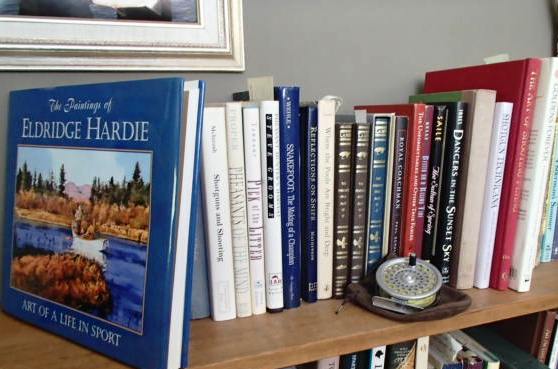
Some of My Favorite Books (An Incomplete List)

 In no particular order, except for the first on the list, these are books that are related to my own art that I have especially enjoyed and that have greatly inspired me. My illustrator uncle and role model Eldridge King gave me the Gene Byrne book when I was just a kid. It had more to do with my becoming an artist than any other single book.

A Complete Guide to Drawing, Illustrating, Cartooning & Painting, Gene Byrne

Winslow Homer books (There are several.)

The Art of Ogden M. Pleissner, Peter Bergh

Sporting Art of Frank W. Benson, Faith Andrews Bedford

The Art of Aiden Lassell Ripley, Stephen O’Brien, Jr.

Francis Lee Jaques-Artist of the Wilderness World, Florence Page Jaques

The Animal Art of Bob Kuhn, Bob Kuhn

Ala Prima, Richard Schmid

Starting with Watercolor, Rowland Hilder

Carlson’s Guide to Landscape Painting, John F. Carlson

Animal Painting and Anatomy, W. Frank Calderon

Drawing on the Right Side of the Brain, Betty Edwards

An Atlas of Animal Anatomy for Artists, Ellenberger, Baum, Dittrich (revised edition)

The Practice & Science of Drawing, Harold Speed

Oil Painting Techniques & Materials, Harold Speed

A Picture Gallery, Tom Lea

A Memory-making Morning

Some hunts you seem to just be paying your dues and then there are mornings like last Sunday. The flights of ducks to our pond beginning at first light were incredible. For over an hour there was never a moment we didn’t have birds working. We’d look each other and say, “Can you believe this?” We passed up many makeable shots waiting for those classic wings-cupped, feet-down, right-over-the-decoys chances. Except for two mallard drakes and a pair of green-winged teal, the rest of our bag were gadwalls. Our Labs were in their glory. After we limited, field dressed our ducks, and had lunch there was plenty of time to scout the pasture creek where we flushed at least two dozen mallards sitting right in front of our blind and more up and down the water there. Mental notes were made for later in the season when the pond is frozen.

A footnote: A friend had scouted the pond the evening before and reported a few hundred ducks on the water. When we arrived in the pre-dawn to set out the decoys, there were no ducks. My guess is that at dusk, the birds moved to one or more of the large reservoirs to roost and were coming back at dawn to feed.  


So Much for “Duck Weather”

Iris with Drake Gadwall

All Done by 8 O’clock

Saturday’s 82 degree high tied a record for the date. Never mind–the birds flew early and steadily, and by eight o’clock we were picking up with Iris having made 13 retrieves that included marked doubles, some long blinds, a pintail drake, a gadwall drake and hen, a mallard drake and nine teal (mostly greenwings.)

New Paintings

Dove Junction

Tails at One O’clock

These are two of my newest paintings. “Dove Junction” has gone to InSight Gallery. “Tails at One O’clock” has been sent to The Sportsman’s Gallery in Atlanta.

Lovely Weather for Ducks

That’s what we had for opening day—rain and wind most of the day. In all my years of waterfowling in Colorado, I’ve only hunted in the rain one other time. We’re spoiled. It made for an interesting day. While the action was kind of slow and the shooting rusty, the dogs each got to retrieve, and we were able get work done on an old blind and a new portable one. We were also able to repair a water diversion gate on the creek and get water out on a field where it should attract both ducks and geese the way it used to before the wash-out last year. As we sat in the creek blind in the afternoon, we watched and listened to quite a display of cock pheasants flying back and forth in a nearby grassy field and even up into a lone Russian olive. At times there were more than a dozen roosters in that tree. We also managed a couple more mallards. Finally, we were caught picking up the decoys prematurely by a small bunch of mallards. When will we learn?

It was a pleasant, though wet, start. No complaints. In the next few weeks the migration should bring us better prospects.